

Patient Resources
The following information is a brief description on some of the procedures we can perform. We provide this resource for you to educate yourself and make you aware of how we can better serve you. Luray Family Dental is dedicated to perserving your dental health.
Dental Hygiene and Periodontal Health
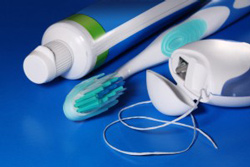 While at our office, we make sure that you receive the highest level of service and ensure that our dental work is of the highest quality. To ensure that you maintain great oral health, this level of quality needs to extend into your personal oral hygiene routine. We can help you establish a dental hygiene routine that will keep your teeth healthy and white. If you have any questions about your current hygiene plan please ask us.
Your teeth are not the only important part of your mouth. Your gums are essential to oral hygiene as well. We can provide periodontal cleanings and treatment, or refer you to one of our recommended specialists. Please let us know if you have any questions.
Periodontal (Gum) Disease ▲return▲
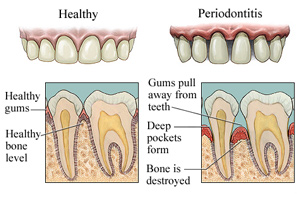 Periodontal (gum) disease is insidious. It is an infection of the gums that starts out as plaque, an opaque film on the teeth that hardens to form tartar. As tartar accumulates, it harbors bacteria that attack the soft tissue around the gums. This is the early stage of gum disease known as Gingivitis. Left untreated, Gingivitis becomes Periodontitis which ultimately destroys the tissue surrounding your teeth AND the bone that holds your teeth in place. Except for bad breath and gums that bleed, there are very few early warning signals. The disease advances silently, often without pain, and before you know it, you are losing your teeth and you don't know why.
Tooth loss is only the most obvious indicator of gum disease. Scientific research has discovered linkage between gum disease and stroke, heart disease, diabetes - even an increased risk for pregnant women. When your gums become diseased, your entire immune system is weakened.
In the past, fear of painful dental surgery has kept people with gum disease from seeking the care they needed. Well, those days are gone forever.
Periodontal Splinting (Weak Teeth) ▲return▲
Loose teeth are uncomfortable, especially when you try to eat food or chew gum. The feeling of the tooth pulling away from the gum is enough to send chills down your spine. It seems like an eternity, waiting for either the tooth to become loose enough to be extracted or strong enough to no longer be a problem.
Teeth become loose because of lost gum tissue, injury, orthodontic treatment, or pressure caused by tooth misalignment. A new technique called periodontal splinting attaches weak teeth together, turning them into a single unit that is stable and stronger than the single teeth by themselves. The procedure is most commonly performed on the front teeth. The procedure is as simple as using composite material to attach, or splint, the loose teeth to the adjoining stable teeth. Tooth splinting is a common procedure that has gained popularity due to its effectiveness.
Life is too short to live with loose teeth.
Scaling & Root Planing ▲return▲
 Gingivitis is a generative disease that left untreated, will cause significant tooth and gum deterioration. Just the word gingivitis can strike panic in a patient’s mind. The reality is that the treatment is simple and performed right in your dentist’s office.
Plaque and tarter that sits on the teeth provides an environment, which allows bacteria to thrive and multiply. The bacteria cause the gums to become inflamed and bleed. The condition becomes more noticeable when you brush your teeth or sometimes when you eat. These are signs of the early stage of gingivitis. Gingivitis is easily treated by having the hygienist scaling and polishing the teeth. If gingivitis is left untreated, the condition will progress and the roots will need a planing. The difference between scaling and root planing is simple. Scaling is the removal of the dental tartar from the tooth surface Root planing is the process of smoothening the root surfaces and removing the infected tooth structure.
As a non-surgical procedure, scaling and planing is performed without any anesthesia, in the dentist’s office. While the procedure is usually painless, advanced stages of gingivitis may make it necessary to numb the area for complete comfort. Deep scaling and root planing is usually broken down into one section of the mouth per appointment. This allows for adequate healing time, and reduces the time for each appointment.
Arestin: Fighting infection where it starts ▲return▲
You may have heard about gum disease, also known as "periodontitis" or "periodontal disease." Maybe a dental professional or hygienist recently told you that you have this infection.
But do you really know the difference between periodontal disease and other types of complications that can affect your mouth, such as gingivitis?
Do you know why it's so important to treat periodontal disease-and why brushing and flossing alone won't do the trick?
Most importantly, did you know that periodontal disease is today's #1 cause of tooth loss among American adults? Or that, although a causal relationship between periodontal disease and an elevated risk for systemic events has not been established,recent data suggest a possible association between periodontal disease and other health issues including cardiovascular disease, diabetes, and preterm low birth-weight babies?
Fight infection right where it starts!
ARESTIN® (minocycline hydrochloride) Microspheres, 1mg is an effective antibiotic treatment that comes in powder form. This powder is placed inside infected periodontal pockets just after the dental professional finishes the scaling and root planing (SRP) procedure.
Sealants ▲return▲
Sealants are a great way to protect against tooth decay and cavities on your back teeth (molars). These are the teeth that are most vulnerable to cavities and decay because they are used in the chewing process, and are the most difficult to reach and clean. Molars first come in at around 5-7 years of age, with a second set coming in between the ages of 11-14. It is best to have a sealant placed when the molars first come in to ensure they are protected early.
To place a sealant an adhesive is first applied to the teeth. The sealant is then placed over the adhesive as a liquid, as if it is painted right onto the tooth. The liquid then hardens and creates a barrier between your tooth and any plaque, food particles, and bacteria. Sealants last for about 10 years and can be reapplied if necessary.
Frenectomy ▲return▲
A frenulum is a piece of tissue that prevents an organ from moving. There is a frenulum that attaches your upper lip to the gums, while another connects the lower lip to the gums. A frenulum that is too short or thick, will cause problems in speech patterns and tooth misalignment. In infants, a shortened frenulum underneath the tongue will inhibit breastfeeding. When the frenulum disrupts movement, growth, or development, corrective action is necessary to resolve the situation.
A frenectomy is a minor surgical procedure that is performed. It can be performed with either a scalpel or laser and takes less than 15 minutes. Using a laser causes very little bleeding and does not require stitches. A laser also results in less postoperative discomfort and a shorter healing time. Young children and infants are put under general anesthesia for the procedure and adults have the procedure performed using local anesthesia. If your child needs a frenectomy, there is nothing to worry about. The procedure is very successful and causes minimal discomfort.
Bonding and White Filling
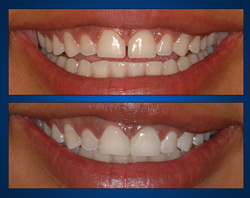 Bonding is a procedure in which a tooth colored resin material is applied to the affected tooth and hardened with a special ultraviolet light that "bonds" the material to the tooth to restore or improve your smile. Dental bonding is most commonly used to:
- Repair decayed teeth (as a filling, after removing a cavity)
- Repair chipped or cracked teeth
- Close spaces between teeth
- Improve the appearance of stained or discolored teeth
Dental bonding takes about 30 to 60 minutes per tooth to complete.
Procedure Details:
Anesthesia is often not necessary unless the bonding is being used to fill a decayed tooth. A shade guide is used to select a composite resin color that closely matches the color of your tooth. Next, the surface of the tooth will be roughened and a conditioning liquid applied. These procedures help the bonding material adhere to the tooth. The tooth-colored, gel-like resin is then applied, molded, and smoothed to the desired shape. An ultraviolet light or laser is then used to harden the material. After the material is hardened, it is further trimmed, shaped, and polished to match the sheen of the rest of the tooth surface.
Crowns ▲return▲
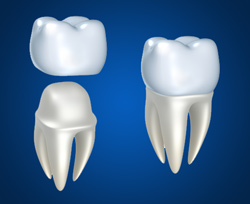 A dental crown is a tooth-shaped "cap" that is placed over a tooth covering the tooth to restore its shape and size, strength, and/or to improve its appearance.
The crowns, when cemented into place, fully encase the entire visible portion of a tooth that lies at and above the gum line.
- Protect a weak tooth from breaking
- Hold together parts of a cracked tooth
- Restore a broken tooth or a tooth that is severely worn down
- Cover and support a tooth with a large filling when there isn't a lot of tooth left
- Hold a dental bridge in place
- Cover a dental implant
- Cover mishaped or severely discolored teeth
A dental crown may be needed to...
- Metals- Metals used in crowns include gold alloy, other alloys (such as palladium), or a base-metal alloy (such as nickel or chromium). Metal crowns withstand biting and chewing forces well and probably last the longest in terms of wear down. Also, metal crowns rarely chip or break. The main drawback to metal crowns is the metallic color. Metal crowns are a good choice for out-of-sight molars.
- Porcelain-Fused-to-Metal- This type of crown is color matched to your adjacent teeth (unlike the metal crowns). Next to all-ceramic crowns, porcelain-fused-to-metal crowns look most like natural teeth. The drawback, however, is that sometimes the metal underlying the crown's porcelain can show through as a dark line, especially at the gumline and even more so in receding gums. Porcelain-fused-to-metal crowns make a good choice for front or back teeth.
- All Resin- All-resin dental crowns are less expensive than other crown types, however, they are least recommended because they wear down over time and are more prone to fractures than porcelain-fused-to-metal crowns.
- All-Ceramic or All-Porcelain- These types of crowns provide the best natural color match than any other crown type and are more suitable for people with metal allergies. All-ceramic crowns are an excellent choice for front teeth.
- Temprary Crowns- Temporary crowns can be made in the office, while permanent crowns are crafted in the dental laboratory. Temporary crowns are made of acrylic or stainless steel and are only used as a temporary restoration until the permanent crown is complete.
Types of Crowns
Permanent crowns can be made from all metal, porcelain-fused-to-metal, all resin, or all ceramic.
The Procedure
Dental crowns take at least two appointments to complete. At the first appointment, the tooth is prepared for the crown-this is the longer appointment. The second appointment involves placement of the permanent crown.
The First Appointment
At the first visit in preparation for the crown, X-rays are taken to check to roots of the tooth and surrounding bone. If the tooth has extensive decay or if there is a risk of infection or injury to the tooth's pulp, a root canal treatment may first be performed.
The first step is to anesthetize (numb) your tooth and the gum tissue around the tooth. Next, the tooth receiving the crown is filed down along the chewing surface and sides to make room for the crown. The amount removed depends on the type of crown used (for instance, all-metal crowns are thinner, requiring less tooth structure removal than all-porcelain or porcelain-fused-to-metal ones). If, on the other hand, a large area of the tooth is missing (due to decay or damage), the doctor will use filling material to "build up" the tooth to support the crown.
After reshaping the tooth, the doctor will use impression paste or putty to make an impression of the tooth to receive the crown. Impressions of the teeth above and below the tooth to receive the dental crown will also be made to make sure that the crown will not affect your bite.
The impressions are sent to a dental laboratory where the crown will be crafted. The crown is usually returned to our office in 3 weeks. During this first office visit the doctor will make a temporary crown to cover and protect the prepared tooth while the crown is being made. Temporary crowns usually are made of acrylic and are held in place using a temporary cement.
The Second Appointment
At your second visit, the doctor will remove your temporary crown and check the fit and color of the permanent crown. If everything is acceptable, a local anesthetic will be used to numb the tooth and the new crown is permanently cemented in place.
Bridges ▲return▲
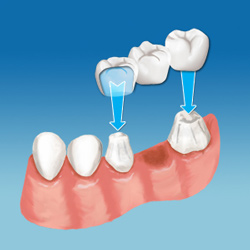 Dental bridges literally bridge the gap created by one or more missing teeth. Your existing teeth are used to literally create a bridge to cross the area where your tooth is missing. Bridges are made from gold, metal, alloys, or porcelain to ensure that they are strong and durable.
- Restore your smile
- Restore your ability to properly chew and speak
- Maintain the shape of your face
- Distribute the forces in your bith properly by replacing missing teeth
- Prevent remaining teeth from drifting out of position
Bridges can help:
The Process:
The process of creating a bridge begins by creating abutments out of your existing teeth where the bridge will be attached. The existing teeth are recontoured to provide a base for the bridge. After the abutments have been created, an impression is taken of the area which is sent to a dental lab. The dental lab uses the impression to create a bridge that will fit properly. The bridge consists of two crowns on either end to place on the abutments and a pontic, which is the new tooth that replaces your missing tooth.
The doctor will fit you with a temporary bridge while we wait for the lab to craft your permanent bridge. This temporary bridge will protect the abutments and the exposed gum areas and look more appealing than having a missing tooth. When the permanent bridge has been created, you will have a follow up visit to set the bridge. It will be placed on the abutments and and an adhesive will also be used to make sure that the bridge is set.
The bridge may take a little while to get used to, but after a few days it should feel like you have your own teeth back again. You should eat soft foods for the first few days after having your bridge placed. After the initial phase, you will be able to eat whatever you want with no issues.
Extractions ▲return▲
Tooth extraction is the removal of a tooth from its socket in the bone.
- Tooth is damaged or decayed beyond repair
- Some people have extra teeth that block other teeth from coming in
- People getting braces may need teeth extracted to create room for teeth that are being moved into place
- People receiving head or neck radiation
- People receiving cancer drugs may develop infected teeth. These drugs weaken the immune system, increasing the risk of infection, hence infected teeth may need to be extracted
- People receiving an organ transplant, if the teeth could become sources of infection after the transplant. People with organ transplants have a high risk of infection because they must take drugs that decrease or suppress the immune system
- Wisom teeth, also called third molars, are often extracted eighter before or after they come in. They often become impacted (stuck in the jaw) and do not come in. They need to be removed if they are decayed or cause pain. Some wisdom teeth are blocked by other teeth or may not have enough room to come in completely. They can irritate the gum, causing pain and swelling, in this case the tooth must be removed.
Reasons for tooth extraction are:
Types of Extractions
- Simple Extraction- A simple extraction is performed on a tooth that can be seen in the mouth. Most of these can be done by using just an injection (a local anesthetic), with or without anti-anxiety drugs. Once the patient is numb, the dentist will grab the tooth using forceps and loosen it by moving the forceps back and forth. Then the tooth will be pulled out. Sometimes the dentist will use a dental "elevator" to help loosen the tooth. This is an instrument that fits between the tooth and the gum.
- Surgical Extraction- A surgical extraction involves teeth that cannot be seen easily in the mouth. They may be broken off at the gumline or may not have come in yet. To see and remove the tooth, the dentist or oral surgeon must cut and pull back the gums. Pulling back the gum flap provides access to remove bone and a piece of the tooth. You may be referred to an oral surgeon for surgical extractions.
There are two types of extractions:
Dentures ▲return▲
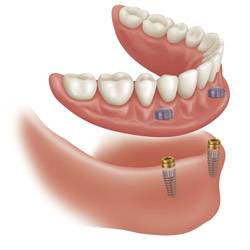 If you have lost some or all of your natural teeth, dentures can replace your missing teeth and improve your quality of life. With a little practice, dentures can make eating and speaking easier. You can smile freely without feeling embarrassed.
A denture is a removable replacement for missing teeth and surrounding tissues. Two types of dentures are available - complete and partial dentures. Complete dentures are used when all the teeth are missing, while partial dentures are used when some natural teeth remain. Replacing missing teeth will benefit your appearance and your health. Without support from the denture, facial muscles sag, making a person look older. You’ll be able to eat and speak—things that people often take for granted until their natural teeth are lost.
Types of Dentures
Complete dentures have replacement teeth fitted into a plastic base. The base is made to closely match the color of your gums. If you still have some natural teeth, they will be removed before your dentures are placed.
Conventional Complete Dentures
A conventional complete denture is made and placed in your mouth after the teeth are taken out and the tissues have healed. Healing may take several months. The base of the upper denture covered the palate (the roof of the mouth). When the base of the upper denture rests against the gums and palate, it makes a seal to hold the denture in place.
The lower denture has a horseshoe shape so there is room for the tongue and muscle attachments. It rests on the gum and bone tissue of the dental ridge. A thin film of saliva holds it in place. The cheek muscles and tongue also help hold the lower denture in place.
Implant Supported Complete Denture
A complete denture may also be attached to dental implants, which provide a more secure fit. SEE IMPLANTS SECTION. Properly placed implants make the denture stable and can help reduce bone loss. Many patients find that implant-supported dentures are more comfortable and secure than conventional dentures. Ask your dentist if you are a good candidate for dental implants.
Immediate Dentures
Some patients may have the option to get immediate dentures. These dentures are made before the remaining teeth are removed. Once the denture has been made at the lab and is ready for you at the dentist’s office, the dentist removes your teeth and the denture is place right away. With immediate dentures, the denture wearer does not have to go without teeth during the healing time. Once healing is complete, the dentures may need to be adjusted or relined. Sometimes a new denture needs to be made.
Dental Implants ▲return▲
Dental implants are a permanent and appealing solution to replace missing or extracted teeth.
They are better than other alternatives like bridges because no additional teeth need to be altered to place the new tooth.
The entire implant process is performed over the course of a few months. The first part of the process is to install the implant itself, where a screw is placed into the jaw bone. An incision is made in the gum so that the implant can be inserted. Multiple implants can be placed at once if necessary. After the implants are placed the gums are sutured.
The implant must be allowed about 3-6 months to heal, and during this time the jaw bone will form around the implant in a process called osseointegration. During this healing time you can have temporary crowns installed so that you can eat and speak normally and maintain a proper aesthetic appearance for your smile.
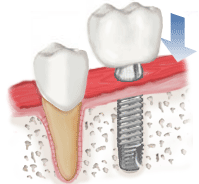
After the implant has healed it is time to place an abutment on the implant. The abutment serves as the base for your new tooth. One this is placed an impression of the abutment is taken and is used to create your permanent restoration. Some offices have an onsite lab to create the crown, but others will have to send it to an outside lab. Once the restoration is completed you can return to the office to attach the restoration permanently. Your smile will look just like it used to, and after a short period of getting used to the implant it will feel just like one of your own teeth.
The diagram below displays just how the implant replaces the tooth :
Root Canal (Endodontics) ▲return▲
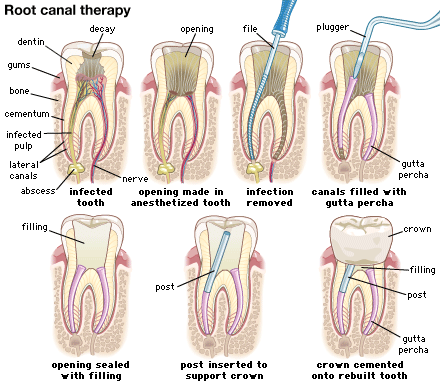 Endodontics is the dental specialty that deals with the nerves of the teeth. Root canals are probably the most notorious procedure in dentistry and the most common procedure relating to endodontics. When a tooth becomes infected it is usually related to the nerves in the root of the tooth. The infected nerves need to be removed. If left untreated an infection can turn into an abscess, which is a much more serious problem that includes bone loss in the jaw.
The area around the tooth is numbed with a local anesthetic to start the procedure. The dentist will then drill down into the tooth to create an opening into the canal. They will then be able to remove infected tissue and clean the canal. After the infection has been removed, the space if filled with a sealant called gutta percha. It is highly recommended that a tooth that has undergone a root canal is fitted with a crown. This will improve the appearance of the tooth, and will also make it much more likely that the root canal is successful.
"Root canal" has become a scary term for dental patients to hear, but the benefits of the procedure and advances in dental technology have made it much less "scary". Local anesthetics and proper pain medication allow the procedure to be performed with little to no pain in most cases. There may be some soreness following the procedure, but that is normal for most dental procedures. Over the counter painkillers are usually enough to relieve any pain afterwards, but your dentist may prescribe medication. The procedure will also relieve you from pain caused by the infection allowing you to enjoy all the foods you love without any pain from heat, cold, or biting too hard. If you are experiencing pain consult your dentist today.
Retreatment ▲return▲
With proper care, most teeth that have had endodontic (root canal) treatment can last as long as other natural teeth. Root canals performed by endodontists (root canal specialists) have a 95% success rate. In some cases, however, a tooth that has received endodontic treatment fails to heal. Occasionally, the tooth becomes painful or diseased months or even years after successful treatment.
Why do I need retreatment?
- Narrow or curved canals were not treated during the initial procedure.
- Complicated canal anatomy went undetected in the first procedure.
- The placement of the crown or other restoration was delayed following the endodontic treatment.
- The restoration did not prevent salivary contamination to the inside of the tooth.
- In other cases, a new problem can jeopardize a tooth that was successfully treated.
As occasionally happens with any dental or medical procedure, a tooth may not heal as expected after initial treatment for a variety of reasons:
New decay can expose the root canal filling material to bacteria, causing a new infection in the tooth. A loose, cracked or broken crown or filling can expose the tooth to a new infection. A tooth sustains a fracture.
- At the initial visit the endodontist will examine the tooth, take x-rays and discuss your treatment options. If you and your endodontist choose retreatment, the retreatment will be scheduled at that time for a future date.
- At the retreatment appointment the endodontist will administer local anesthetic to numb the tooth. After the tooth is numb, the endodontist will reopen your tooth to gain access to the root canal filling material. In many cases, complex restorative materials (crown, post and core material) must be disassembled and removed to permit access to the root canals.
- After removing the canal filling, the endodontist can clean the canals and carefully examine the inside of your tooth using a microscope, searching for any additional canals or unusual anatomy that requires treatment.
- After cleaning the canals, the endodontist will fill and seal the canals and place a temporary filling in the tooth. Post space may also be prepared at this time.
- After your endodontist completes retreatment, you will need to return to your dentist as soon as possible to have a new crown or other restoration placed on the tooth to protect and restore it to full function.
- If the canals are unusually narrow or blocked, your endodontist may recommend endodontic surgery.
Retreatment is performed in two visits and involves the following:
Night Guards ▲return▲
Many people are afflicted with bruxism, or teeth grinding. Some people may do this consciously during the day, but it is a larger problem at night while you are asleep. Grinding your teeth can damage enamel, wear down teeth, cause jaw pain, or irritate your gums. The noise from teeth grinding can also disturb your spouse's sleep if loud enough.
If you grind your teeth you should consider a night guard. The night guard, which is very similar to a mouth guard worn by athletes, provides a barrier between your top and bottom teeth while you sleep. All night guards are custom fitted for comfort and to allow for proper breathing. Your dentist will take an impression of your teeth and have the night guard created by a dental lab. Night guards are very durable and can be used for up to 10 years.
There are also some things that you can do to try to stop teeth grinding. You can train your jaw to be free and easy rather than clenched. Refrain from chewing gum or on other objects like pens. You should also avoid alcoholic drinks and drinks with caffeine, as these may increase the likelihood of teeth grinding. If you suspect you might be grinding your teeth at night set up an appointment with us today.
Whitening and Bleaching ▲return▲
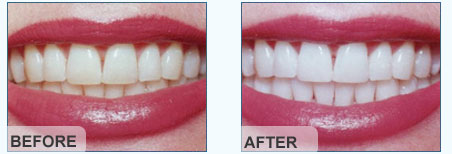 Keeping our teeth their whitest is a lot harder than it sounds. With all the coffee, wine, smoking and other foods that have the ability to stain our teeth on a daily basis, even proper maintenance sometimes leaves them a little lackluster. Teeth whitening is an excellent way to restore the natural color of your teeth or even make them whiter than your natural color.
To accomplish the whitening of your teeth, we utilize a tray whitening system. This tray whitening system is completed in 2 steps. The first step is to make an impression of your teeth. With this impression, we'll craft you customized whitening trays that you can use over and over. Finally, you will take the whitening gel and put it in the gel for a short period of time over a period of a few days. This often results in a whiter smile of 4 - 8 shades!
Veneers ▲return▲
 Dental bridges literally bridge the gap created by one or more missing teeth. Your existing teeth are used to literally create a bridge to cross the area where your tooth is missing. Bridges are made from gold, metal, alloys, or porcelain to ensure that they are strong and durable.
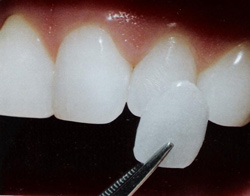
Veneers are an excellent way to redesign and reshape your entire mouth. Veneers are made of a very thin ceramic shell that covers your existing tooth structure. By placing these new veneers on your teeth, you are able to fix the look of issues such as staining, cracked teeth, spaces, misaligned teeth, chipped teeth and many other issues.
The Process:
The process that takes approximately two to three visits. In the first visit, we will discuss the new shape and look of what we are going to accomplish by placing the veneers. Once we have put a plan in place, we will carefully prepare the teeth for the placement of the new veneers. As we complete this piece of the process, the next step is to take an impression of the newly prepared teeth. This impression will be sent to our laboratory for the final product to be fabricated. We only utilize the highest standard laboratory for fabrication of all of our work. This process at the laboratory takes between 10-14 days. While the new veneers are being fabricated at the lab, we will provide you with a beautiful temporary solution to wear for this time.
As the veneers are finalized, we will make every effort to make sure that your new veneers will feel just like your natural teeth. We will bond them into place ensuring that you can enjoy your new smile for a very long time.
Occlusal Adjustment ▲return▲
Do you wake in the morning with sore jaws?
When you bite, do you feel like your jaw is lopsided? If so, then you may need an occlusal adjustment.
An occlusal adjustment corrects the alignment of the bite, that is a result of loose, shifting, crowded, or missing teeth. The result is an evenly distributed bite that eliminates irregular pressure on one side of the mouth. Once your bite is adjusted, your teeth will meet properly. Occlusal adjustment causes minimal pain, and only a little discomfort. The adjustment is made by using a dental drill using a fine filing stone. In addition to the actual adjustment, removal mouthpieces are also utilized, to protect the tooth surface, and relax the jaw muscles once the adjustment is completed.
Who is a good candidate for an occlusal adjustment? Patients with loose or shifting teeth will many times not meet correctly. Patients, who grind or clench their teeth, will have an uneven bite and pressure distribution in the mouth, which is also corrected through an occlusal adjustment. Sometimes tooth sensitivity can be corrected through an occlusal adjustment as the treatment reduces pressure on the sensitive tooth.
New technology allows dentists to accurately identify the areas, which need adjustments. The dentist utilizes a computer scan of the mouth, which records hundreds of bite registrations per minute, and notes even the slightest irregularity. That data allows the dentist to make only the adjustments that are absolutely necessary, which ensures a well aligned bite and minimal tooth wear.
If you suspect that you may need an occlusal adjustment, schedule an appointment.
Post-Op Instructions ▲return▲
It is important to follow instructions after you have dental work to ensure proper healing and to avoid complications. As a rule of thumb, you should always wait two hours after any major procedure before eating to let the anesthesia wear off. Trying to eat before this could result in soft tissue damage because you are not able to feel all of your mouth. The instructions found below are guidelines. After your procedure the doctor or dental assistant will give you full post-op instructions.
Root Canal Therapy
You can expect soreness after a root canal procedure for a few days. You should avoid chewing on the side of your mouth where the procedure was performed so you do not irritate the area and also to ensure that the temporary restorative material properly sets. You will also need to take an antibiotic to treat any remaining infection in your tooth. If you notice an increasing amount of pain or tenderness, a reaction to the medication, or the loss of the temporary restoration (filling) call your dentist immediately.
Crowns and Bridges
Before you receive your permanent crown/bridge you will first receive a temporary restoration. This is not as sturdy as the permanent version, so you should be careful when cleaning and eating. You should brush the area gently and should not pull up on the tooth when flossing because it could become dislodged. The same goes for eating. You should avoid sticky or chewy foods while you have the temporary in.
There may be some sensitivity and irritation after the temporary or permanent is placed. This is normal and will subside after the soft tissue heals. A warm salt water rinse will help, and you can also take Advil or Tylenol if the pain does not go away.
When the permanent crown or bridge is placed it may feel a little awkward for a few days. Your mouth needs to adjust to the new tooth, and it should feel like one of your natural tooth in less than a week. If your bite feels abnormal in any way, you should let your dentist know. Caring for your bridge or crown is just like caring for your own teeth. You should brush and floss regularly.
White Fillings (Bonding)
After the anesthesia wears off your teeth will likely be sensitive. You should avoid hot and cold food or drink for the next few days. After that initial period, your treated teeth will feel as good as new. Continue your normal hygiene plan to ensure that your fillings last for a long time.
Scaling and Root Planing
After this procedure your gums will probably be slightly sore and irritated for a few days. You should rinse your mouth with warm salt water (1 tsp salt/8 oz water) 2-3 times a day. This will relieve the pain and cleanse the area. Brushing and flossing should be continued right after the procedure, but you should brush gently so that you do not further irritate the area. If you experience any swelling or stiffness in the area you can place a cold compress on the area and take some pain relieving medicine. Avoid any hard or chewy foods for 2-3 days after the surgery to ensure the area heals correctly. If you continue to experience pain or swelling after a few days contact your dentist.
Veneers
Before you receive your permanent veneer you will first receive a temporary restoration. This is not as sturdy as the permanent version, so you should be careful when cleaning and eating. You should brush the area gently and should not pull up on the tooth when flossing because it could become dislodged. The same goes for eating. You should avoid sticky or chewy foods while you have the temporary in.
There may be some sensitivity and irritation after the temporary or permanent is placed. This is normal and will subside after the soft tissue heals. A warm salt water rinse will help, and you can also take Advil or Tylenol if the pain does not go away.
When the veneer is placed it may feel a little awkward for a few days. Your mouth needs to adjust to the new tooth, and it should feel like one of your natural tooth in less than a week. If your bite feels abnormal in any way, you should let your dentist know. When brushing and flossing you should pay close attention to the area between the veneer and the tooth at the gum line.
Extractions
After the surgery you will need to rest. You need to be driven home by a friend or family member because of the anesthesia. You can expect for the extraction site to bleed for a little while after the surgery. Gauze will be applied at the completion of the surgery, and you will need to change it when it becomes soaked. If bleeding continues for longer than 24 hours you should call your dentist. Rest when you return home, but do not lie flat. This could prolong the bleeding. Prop your head up on a pillow when lying down. Your dentist will prescribe you pain medication, so if you become sore take as directed. You can also use an ice pack for the pain. Your dentist might also provide you with a cleaning solution to clean the extraction site.
- Gelatin
- Pudding
- Yogurt
- Mashed Potatoes
- Ice Cream
- Thin Soups
- ...and other food you can eat without chewing.
You will be limited to soft foods for a few days after your surgery. Some recommended foods are:
When drinking, make sure you do not use a straw. The sucking motion can loosen your sutures and slow the clotting process. The same goes for smoking. If you have prolonged pain, bleeding, irritation, or don't feel that the extraction site is healing properly call your dentist for a follow up.
Getting used to your Dentures
New dentures may feel odd or uncomfortable for the first few weeks. This is normal. Keep wearing your dentures until you get used to them. The lower one may feel especially loose until the muscles of your cheeks and tongue learn to hold it in place. You may have extra saliva for a short time. Some soreness should be expected for the first week or two. Your dentist will check on your progress and make any adjustments needed to make you more comfortable.
- Begin by eating soft foods cut into small pieces.
- Chew on both sides of the mouth to keep the pressure even.
- Do not eat very sticky or hard foods or chew gum.
When you replace missing teeth, eating is easier. But it takes practice. Here are some things that can help:
You will also need to practice talking with your new dentures. Try reading out loud and repeating tricky words in front of a mirror. Talk slowly to prevent muffled speech. If your dentures slip out of place when you laugh, cough, or smile, bite down and swallow to reposition them.
When you get new dentures, you should wear them most of the time. After the adjustment period, dentures should not be worn 24 hours a day. Your dentist may tell you to take out the denture at bedtime and put it back in when you wake up. Do not wear dentures around the clock because tissues that are covered with denture material all the time can become irritated.
Denture Adhesives
Your new dentures should fit securely, but you may use denture adhesive as you get used to wearing them. A denture that does not fit well may cause irritation, mouth sores and infection. While denture adhesive can help a loose fitting denture for a short time, using adhesives all the time is not recommended. If the denture is loose, have your dentist check it. If you are using an adhesive, make sure you follow the instructions for use.
- Clean your denture every day. Take it out of your mouth and carefully rinse off loose food particles. Wet the brush and put the denture cleaner on it. Brush all the surfaces gently to keep from damaging the plastic base.
- It is best to use a special brush made for cleaning dentures, but you can use a toothbrush with soft bristles. Do not use hard-bristled brushes because they can damage dentures.
- A liquid soap can be very effective when used with a denture brush. However, toothpaste should not be used to clean dentures. Some toothpastes have abrasive particles that can damage the denture base.
- Your denture is very delicate and can break if dropped even a few inches on a hard surface. Stand over a folded towel or a sink with cool water when holding your denture.
- Keep your denture in water when you’re not wearing it. Do not let it dry out or it can lose its shape.
- Rinse the denture well after using any denture cleanser. It may contain chemicals that are not intended to go into the mouth.
- Look for dentures cleansers with the American Dental Association Seal of Acceptance, a symbol of safety and effectiveness.
- Keep your denture away from curious children and pets when you’re not wearing it.
Caring for Dentures
Like natural teeth, dentures require daily oral hygiene. Here are some tips to care for your dentures:
Caring for your Mouth
Even if you wear full dentures, you still must take good care of your mouth. Brush your gums, tongue, and palate every morning with a soft-bristled brush before you put in your dentures. This increases circulation in your tissues and helps remove plaque. Eating a balanced diet is also important to keep your mouth health.
You will still need regular oral exams by your dentist even after you have lost your teeth.
- Give yourself plenty of time to get used to your dentures.
- Eat a balanced diet for good health.
- Practice eating and speaking with your denture.
- See your dentist regularly.
YOUR NEW SMILE
You are the key to your new smile’s success. These four tips will help:
VIP Ammenities ▲return▲
Our office offers amenities and interesting extras to make each visit with us an enjoyable experience. Our goal is to provide high quality dental care while putting you in the most comfortable setting possible. Our facility is one whose dental program is run under the strict supervision of a licensed dentist.
- Head Rest Pillows
- Blankets
- Flat Screen TV's
- Soothing Music
- Laughing Gas (Nitrous Oxide)